Should You Replace Two Tires or All Four? Here's the Answer
Many car owners face this exact dilemma: during a routine check-up or after noticing uneven wear, the question comes up directly — is it enough to replace just two tires, or should all four be replaced together? The answer isn't the same in every case. It's governed by precise technical criteria that determine the right decision — not simply a matter of personal preference or cutting costs. In this article, we break down the topic in a simple way to help you make the right call for your safety and the safety of everyone in the car.
Why Don't All Four Tires Wear at the Same Rate?
The first thing to understand is that wear patterns differ from tire to tire depending on its position on the car. In most front-wheel-drive vehicles, the front tires carry the weight of the engine in addition to handling steering and braking, which makes them wear faster than the rear tires. Wheel alignment, tire pressure, and driving habits also play a role in creating different wear rates even within the same car.
When Is It Enough to Replace Just Two Tires?
You can get away with replacing only two tires in the following cases:
If the car has front-wheel or rear-wheel drive only (2WD), not all-wheel drive.
If the remaining two tires are still in good condition, with tread depth close to that of new tires.
Most importantly: the two new tires must always be installed on the rear axle, not the front — even if the actual wear happened on the front tires. This is a globally recognized standard among tire manufacturers, because new tires provide better stability during sudden braking or cornering, while an older tire on the front axle is more prone to hydroplaning, especially in wet conditions.
When Is Replacing All Four Tires a Necessity, Not a Luxury?
There are certain situations where replacing just two tires is the wrong call and can expose the driver to real risk:
First: All-Wheel Drive and Four-Wheel Drive Vehicles (AWD/4WD) In these vehicles, even a small difference in tire diameter between a new and an old tire causes each wheel to rotate at a different speed. This mismatch puts strain on the differential, leading to costly damage over time. Most manufacturers recommend replacing all four tires together in AWD/4WD vehicles.
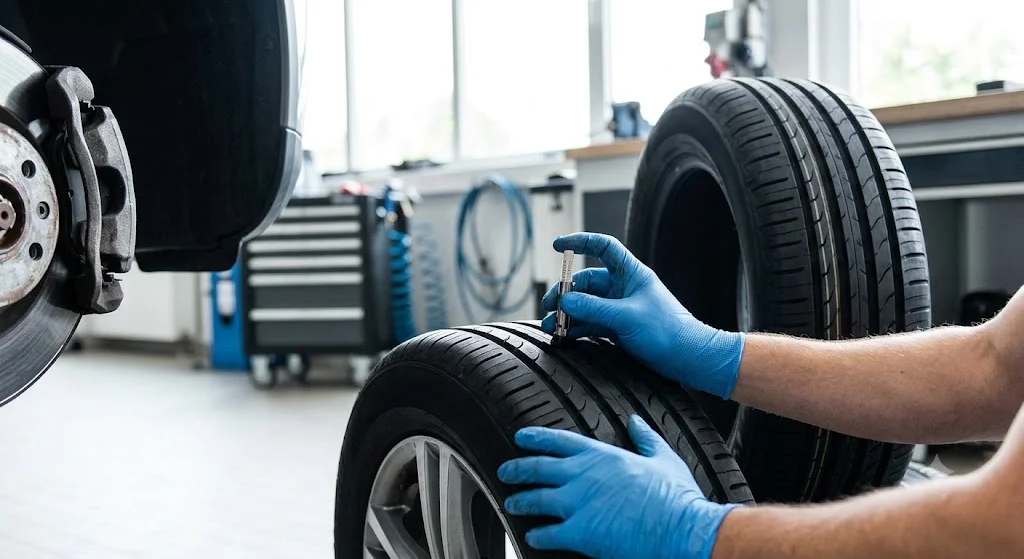
Second: When Wear Is Similar Across All Four Tires If an inspection shows that tread depth is roughly the same across all four tires and has reached the replacement threshold (typically 1.6 mm or less), the better option is to replace all four at once. The small difference in cost is far outweighed by the difference it makes in balance and safety.
Third: After a Long Period of Use Even if a tire looks fine on the outside, rubber gradually degrades due to heat and UV exposure — a real concern in Kuwait's intense heat. Most manufacturers recommend inspecting or replacing tires after five to six years from the manufacturing date, regardless of mileage.
How Can You Tell a Tire's Real Age?
Every tire has a four-digit code printed on its sidewall representing the week and year of manufacture. For example, the code "2224" means the tire was made in the 22nd week of 2024. This code tells you the tire's true age, independent of its outward appearance or the number of kilometers driven.
A Practical Tip Before You Decide
The best way to determine what your car actually needs is to regularly check tread depth and tire pressure across all four tires, rather than relying on visual inspection alone. If your car has all-wheel drive, or if the difference in wear between tires is noticeable, replacing all four tires is the safer and more reliable choice in the long run.
For those in Kuwait looking for reliable tires, stores like b2b.com.kw offer a wide range of options suited to most car sizes, from well-known brands such as Zextour, Tracmax, and Firestone, with the ability to select the right size based on your vehicle. Some stores also offer home delivery and installation service, a practical option that saves time and effort, especially when replacing all four tires at once.
Conclusion
The decision between replacing two tires or four isn't a matter of personal taste — it's a matter of safety and mechanical balance. Check your car's drivetrain type, compare tread depth across tires, and confirm their actual age before making your decision. A new tire is a small cost compared to the safety it provides for you and your passengers.