Original or Aftermarket Parts? How to Choose What's Right for Your Car
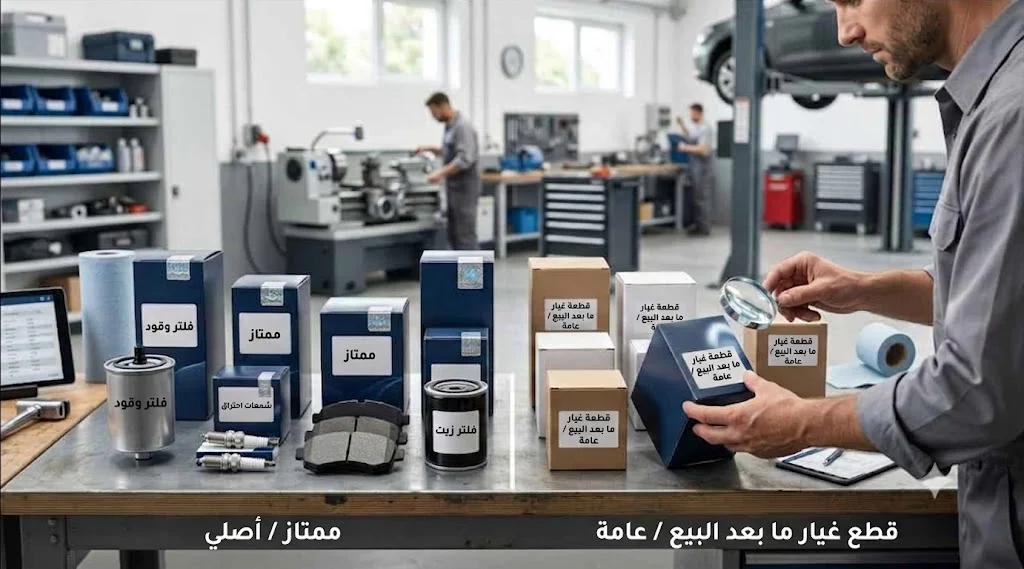
When your car needs maintenance or a part replaced, you'll usually run into the same question: should you buy original or aftermarket parts? It might seem like a decision based purely on price, but in reality it depends on the type of part, its quality, and how well it fits your car.
In Kuwait's hot, dusty conditions, it's best not to decide on price alone — choosing the wrong part can lead to weaker performance, repeated breakdowns, and extra cost down the road.
What Are Original Parts?
Original parts are sold under the name of the car's manufacturer and are designed to match the exact specifications of a specific model. They're generally easy to verify for fit, especially when you search using the VIN (Vehicle Identification Number) or the part number.
Car manufacturers note that original parts are made to each vehicle's exact specifications, which reduces the chances of sizing or installation problems.
That said, this doesn't mean an original part is always the only option — it can cost more, and some parts may take longer to source.
What Are Aftermarket Parts?
Aftermarket parts are made by companies independent of the car's manufacturer. They come in different quality and price tiers: some are budget options, while others are produced by global companies to standards close to original equipment specifications.
For example, DENSO states that some of its aftermarket products are manufactured to original-equipment quality standards, showing that labeling a part "aftermarket" doesn't automatically mean it's low quality.
So the real distinction isn't between "good original" and "bad aftermarket" — it's between a reliable, compatible part and one of unknown quality or a poor fit for the car.
Aftermarket Is Not the Same as Counterfeit
It's important to distinguish between an aftermarket part and a counterfeit part. An aftermarket part clearly carries the name of the company that made it, while a counterfeit tries to imitate another brand's logo or packaging to mislead the buyer into thinking it's original.
The World Intellectual Property Organization warns that counterfeit auto parts can pose clear safety risks, especially when used in sensitive systems.
So avoid parts of unknown origin even if the price is tempting, and don't rely on packaging alone as proof of authenticity.
When Is Choosing an Original Part Better?
Original parts — or high-quality, certified alternatives — matter most for components directly tied to safety or the car's electronic systems, such as:
Airbag and ABS system components.
Sensors and electronic control units.
Steering system and engine timing parts.
Parts whose aftermarket compatibility can't be verified precisely.
New cars still under warranty.
In all these cases, check the owner's manual and your car's warranty terms in Kuwait before installing any part, since conditions vary by manufacturer and dealer.
When Are Aftermarket Parts a Practical Choice?
A trusted aftermarket part can be a good choice for many maintenance and consumable items, such as wiper blades, filters, batteries, bulbs, and some body parts, as long as the size and specifications match and the brand is well known.
On the B2B Auto website, for instance, you can find an 18-inch Denso wiper blade made in Malaysia, alongside other options like a 14-inch YHO wiper blade made in China. The choice here doesn't depend on country of manufacture or price alone, but on the right size, wiper arm design, and product quality.
Before You Buy — Check These Points
To choose correctly between original and aftermarket parts, follow these steps:
Match the part number: Use the VIN or the old part's number — don't rely on the car's model name alone.
Check the specifications: Confirm the size, voltage, viscosity, load capacity, and any other technical code.
Choose a trusted brand: Some independent bodies test aftermarket parts for materials, manufacturing, and installation precision, so a reliable certification is an added sign of quality.
Ask for an invoice and warranty: Keep proof of purchase in case of a defect or mismatch.
Calculate the total cost: A cheaper part isn't actually a saving if it needs replacing again soon.
The same applies to oils and filters. For example, the 20W50, 6-liter oil change service at B2B Auto includes an oil filter change, but it's only suitable for cars whose manufacturer instructions allow that viscosity — so don't choose oil based on the weather alone.
Bottom Line: Don't Decide on Price Alone
There's no single answer that fits every car. Choose an original part when precise fit and safety are the priority, and choose a trusted aftermarket part when it's from a known brand, matches your car's specifications, and comes with a clear warranty.
And the most important rule: never buy a part of unknown origin, and never install any product before confirming its number and specifications. The right choice protects your safety, reduces breakdowns, and saves you the cost of replacing the part all over again.
